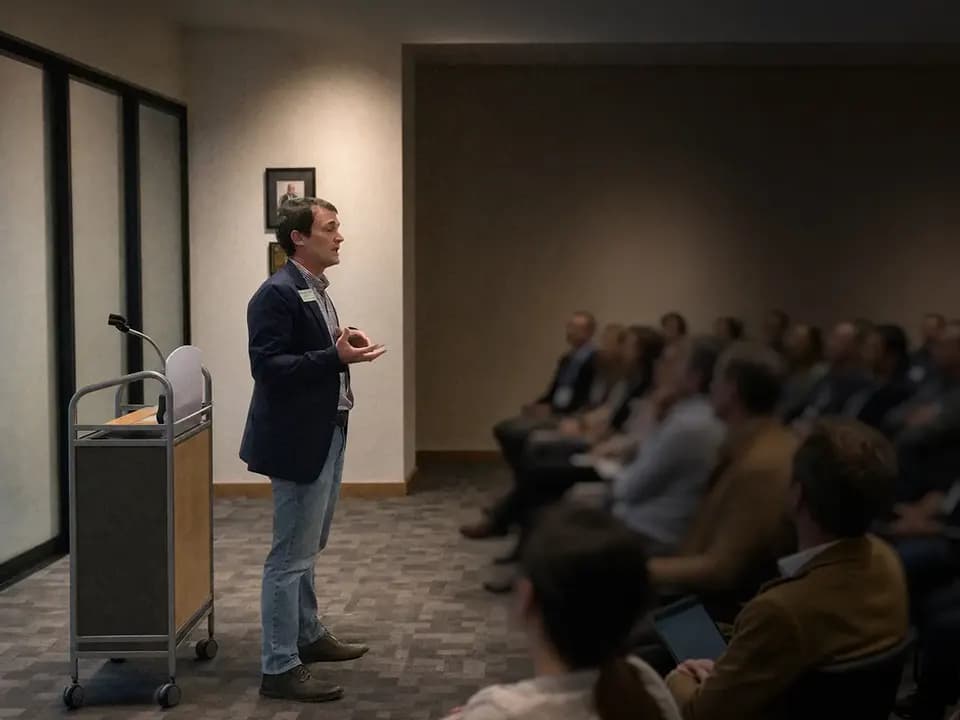
Keynote topic
Government Leadership Keynote Speaker - George Stern
George Stern ran the 2020 Jefferson County presidential election under sustained threats, was profiled on CBS 60 Minutes in 2022, and won the 2020 EAC Clearinghouse Award. He is the keynote public-sector buyers book when they need someone who has actually run a government operation under hostile conditions. Audiences leave with the operating discipline and the civic legitimacy paired honestly, not traded against each other.
Elected officials do the hardest version of the leadership job. The operating standard is private-sector. The accountability is civic. The resources are constrained. The temptation is to pick two of the three and apologise for the third. George books for rooms that refuse the false trade. He has done the work – as an elected Jefferson County Clerk and Recorder running a 115-person agency under threat – and he carries the operating discipline of McKinsey, Harvard Law, and the Obama White House Counsel's Office into a context where citizens, not shareholders, are the audit.
Or reach the team directly — GeorgeStern@clash.cc






Why the right voice
Why an elected official who delivered an election under sustained threats
George was the elected Jefferson County (Colorado) Clerk and Recorder running a 115-person agency. He delivered the 2020 presidential election under sustained threats - CBS 60 Minutes profiled the operation in 2022, and the US Election Assistance Commission awarded Jefferson County the 2020 Clearinghouse Award. He is a Harvard Law magna cum laude graduate, Obama White House Counsel's Office alumnus, and McKinsey alumnus. He is an active volunteer firefighter at Aspen Fire Protection District, and is now CEO of G&P LLC, which acquired a mid-seven-figure US digital agency in January 2026.
- Harvard Law
- Obama White House
- McKinsey
- Former elected official
“One of the most talked-about moments of the offsite.”Jeff Haars, VP, Amentum (NASA contractor)
On stage
The first five seconds decide the call.
A firehouse story that lands the same in your boardroom. George teaches emotional intelligence as an operating skill — pause, understand what’s actually happening, respond with clarity. Not about being soft; about not letting ego make the next decision.
What the room walks away with
Tools the audience uses the next morning.
The room leaves with three pairings that public-sector leaders are usually asked to choose between and rarely get to combine. Operating discipline plus civic legitimacy – imported from McKinsey, Harvard Law, and the Obama White House Counsel's Office on one side, and elected service on the other. Calibrated action plus public accountability – decide at 40-70%, name the unknowns, debrief the call where the citizens can see it. Private-sector cadence plus public-sector mandate – run the operation like a serious business and answer to the public the way a serious office should. Agency leaders leave with the operating language. Elected officials leave with the legitimacy frame.
- 01
The 2020 Jefferson County election as the working example of operating discipline paired with civic legitimacy.
- 02
How private-sector operating cadence transfers cleanly into a public-sector mandate.
- 03
Calibrated action under hostile conditions - decide at 40-70%, name the unknowns, debrief in public.
- 04
Why the operating discipline and the civic mission are not a trade-off - and how to stop running them as one.
- 05
Language elected officials and career agency leaders can both use in the same operating meeting.
The contrarian bit
Why most government leadership talks pick the wrong half
One half of the government-leadership conversation imports a private-sector cadence and quietly drops the civic legitimacy. The other half hugs the civic mission and assumes the operation will run itself. Most public-sector rooms have been served one or the other for years – and neither half survives a Tuesday in the office.
George refuses the trade. He ran a 115-person Jefferson County agency through the 2020 presidential election under sustained threats, with operating discipline carried over from McKinsey, Harvard Law, and the Obama White House Counsel's Office, and with civic legitimacy that came from being elected to the office and answering to the same voters whose ballots he counted. The keynote uses that operation as the working example of what it looks like to pair both halves honestly.
In the week that follows, the team's own language shifts. Agency leaders stop apologising for running their office like a serious business. Elected officials stop treating operating discipline as a private-sector luxury. The team has language for the moment when an operating standard and a civic obligation appear to pull in different directions – and a method for resolving it that does not sacrifice either.
Questions
Government and Public Sector Leadership — booking George.
Yes. George reads the brief with the buyer – mandate, recent operational pressure, the parts of the office that have to be visibly accountable – and adjusts the anchor scenes. A civic forum gets a different cut to a federal agency leadership programme or a state-level executive development series.
Still deciding? Talk it through with the team.
Other topics George speaks on
- Generational Leadership Keynote Speaker - George Stern
- Leading Under Pressure Keynote Speaker - George Stern
- Firefighter Leadership Keynote Speaker - George Stern
- Change Management Keynote Speaker - George Stern
- Practical Leadership Keynote Speaker - George Stern
- Frontline Leadership Keynote Speaker - George Stern
Booking
Bring this keynote to your team.
In-person, US · virtual & workshop formats on request · the team replies within 24 hours.
Back to George’s full profile“One of the most talked-about moments of the offsite.”— Jeff Haars, VP, Amentum (NASA contractor)
Represented by Clash Creation · clash.cc